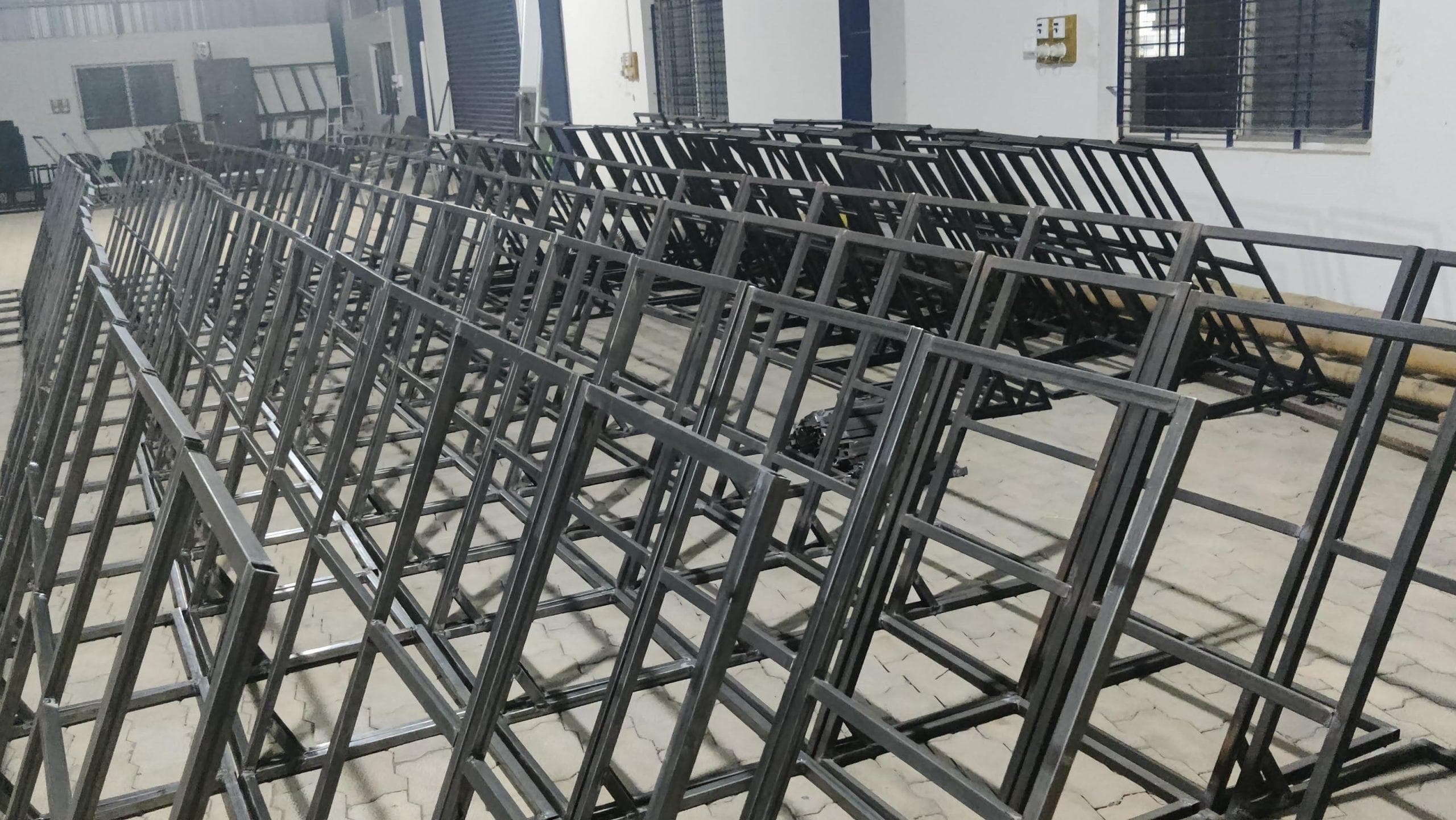
The metal hardware behind every sign — the MS frame inside a lightbox, the pole of a pylon, the backing plate of a channel letter, the bracketry that holds a fascia panel onto a wall — has a finish on it. That finish is what stands between the steel and the monsoon. Three finish systems dominate Indian signage hardware: powder coating, wet paint (typically PU or epoxy), and anodising. Choosing wrong is the single biggest cause of structural sign failure within the first three to five years.
Powder coating is the modern standard for fabricated MS and aluminium hardware. The process: clean and pre-treat the metal (degrease, phosphate or zirconium conversion coating), apply electrostatically charged dry powder (epoxy, polyester, epoxy-polyester hybrid, or polyester-TGIC for outdoor), then bake at 180 to 200 degrees Celsius for 12 to 20 minutes to fuse and cure the powder into a continuous film. Final film thickness is typically 60 to 100 microns. The coating is hard, impact resistant, and chemically robust. Polyester and polyester-TGIC are the outdoor-rated families — both offer good UV stability, gloss retention, and chalking resistance for five to ten years outdoor in Indian conditions. Epoxy alone is indoor only because it chalks aggressively in UV.
Wet paint is the older standard but still relevant. Epoxy primer plus polyurethane (PU) topcoat is the marine and industrial finish — used on fabricated structural steel that has to withstand coastal exposure, on signage hardware in chemical or industrial environments, and on retouchable applications where powder coating cannot be reapplied without removing the part to a baking oven. The film thickness is typically 40 to 80 microns total (15 to 25 micron primer, 25 to 50 micron PU topcoat). Done well — proper surface prep, two-pack chemistry, controlled application — wet PU outlasts powder in some conditions, particularly chloride-heavy coastal sites. Done poorly with single-pack synthetic enamel, it fails inside two years.
Anodising is electrochemical and applies only to aluminium. The process electrolytically grows an oxide layer on the surface, then dyes and seals it. Typical anodised film thickness is 10 to 25 microns for architectural use. The advantage is that the oxide is part of the metal — it cannot peel, chip, or flake. The disadvantage is colour range (limited to bronze, black, gold, champagne, clear, and a few greys), reduced surface flexibility (forming after anodising can crack the film), and higher cost than powder coat. Anodising is the right finish for premium aluminium extrusions, framing systems where exposed cut edges are unavoidable, and architectural signage where the brushed-metal look is a design choice. ACP panels are anodised at the coil mill — the PVDF or polyester coating discussed in our ACP article is the equivalent of architectural finishing applied at source.
The failure modes. Powder coating fails by edge corrosion when the pre-treatment was inadequate. The classic Indian signage failure: a powder-coated channel letter back panel develops rust at the bolt holes or at the cut edges within fourteen to eighteen months. The cause is almost always inadequate phosphating before powder application — a shortcut to save 15 percent on processing cost that costs the client a complete refurbishment in three years. Specify zirconium pre-treatment for premium work or full eight-stage phosphate process at minimum, in writing. Powder also fails by mechanical damage at install — scratches and impact during handling penetrate to the steel and start a corrosion site.
Wet paint fails by chalking — UV degradation of the resin reveals pigment as a chalky surface dust — and by single-pack failure when synthetic enamel is used instead of two-pack PU. Always specify two-pack PU with isocyanate hardener mixed within pot life. Single-pack alkyd enamel is unsuitable for outdoor signage hardware regardless of cost.
Anodising fails primarily through poor sealing. After dye uptake, the porous oxide layer must be sealed with hot water or nickel acetate to lock the dye in and close the porosity. Inadequate sealing causes dye fade and water staining within two to three years. The sealing step is invisible in the finished part, so it requires a trusted vendor or third-party verification.
The spec questions for procurement. One: pre-treatment process — eight-stage phosphate, zirconium, or chromate (chromate is being phased out in India under environmental rules). Two: powder type — polyester, polyester-TGIC, polyester-epoxy hybrid, or epoxy. Three: film thickness with measurement method (typically Elcometer reading). Four: colour reference (RAL number or brand colour code) and gloss level. Five: warranty against gloss loss, chalking, and corrosion. Six: salt spray test certification — quality outdoor powder should pass 500 hours minimum to ASTM B117 standard, premium spec 1000 hours.
Galvanising should be mentioned because it underlies everything outdoor. For exposed structural members, hot-dip galvanising before powder coating is the gold-standard sequence. The galvanised zinc layer (typically 50 to 80 microns by hot dip) provides cathodic protection even if the powder coat is breached by impact or scratch. Powder coat on galvanised steel is what we call duplex coating, and it is what separates a 15-year structural life from a 5-year one. For pylons, large signage frames, and any hardware with structural responsibility, specify galvanised then powder coated, not just powder coated on bare CR sheet.
Cost benchmarks May 2026. Powder coating on fabricated MS, including pre-treatment, single colour, standard polyester: rupees 35 to 55 per square foot of surface area. Polyester-TGIC outdoor grade: rupees 45 to 70. Wet PU two-pack with epoxy primer: rupees 55 to 90 per square foot, depending on geometry and accessibility. Anodised aluminium architectural finish: rupees 80 to 150 per square foot. Hot-dip galvanising of fabricated MS: rupees 25 to 45 per kg of fabrication weight.
The procurement reality. The cheapest finish quote in your tender almost always comes from a vendor cutting the pre-treatment, the dry film thickness, or the powder grade. Demand the spec in writing, ask for a salt spray certificate, and document the finish on the AMC handover so future inspections can verify the original specification.
We log finish specifications on every fabrication job and reference them in the maintenance schedule on /amc and the structural compliance pack on /quality.
A few additional procurement considerations. Touch-up and field repair capability is the real-world distinguisher between finishes. Powder coating cannot be reapplied at site — any field damage requires the part to be removed, stripped, re-powdered, and re-baked. For permanent installations this is impractical. The realistic field repair for powder-coated hardware is a colour-matched touch-up paint (single-pack alkyd in the matching RAL) which never quite matches the original sheen but is acceptable for minor blemishes. Wet PU two-pack can be touched up in the field with the original two-pack chemistry, which is one of its real advantages for maintenance scenarios — bridges, large structural signage, hardware in installations where part removal is difficult. Anodised aluminium cannot be touched up at all; field damage requires the part to be replaced.
Thickness measurement on finished hardware is a verification step procurement teams should add to the inspection protocol. An Elcometer dry-film thickness gauge measures coating thickness on metal substrates non-destructively. The spec calls out the target thickness range; the inspection verifies it. For powder coating, target is 60 to 100 microns with rejection criteria below 50 or above 120. For wet PU two-pack, target 40 to 80 microns. Random spot checks at six to ten locations per piece is the standard inspection pattern for fleet fabrication runs. We provide thickness measurement records on every quality-assured fabrication job — see /quality for the format.
Colour fastness over time is the other procurement metric worth tracking. Specify the colour by RAL number or by Pantone reference, not by description (saying dark grey is not a specification). Hold a master colour sample at the warehouse for the project life, and verify replacement parts and field touch-up against the master sample, not just the original specification. This is how multi-site rollouts maintain visual consistency over a five to ten year programme.
Galvanising thickness for the duplex coating system underlying outdoor structural hardware should be specified as IS 4759 standard, with hot-dip galvanising thickness of 65 microns minimum for general signage hardware and 85 microns for structural members exposed to coastal or industrial environments. The galvanising certificate should accompany the hardware delivery.
Send your hardware drawing list, the install location, and the operating environment description to /contact for a finish recommendation per piece including pre-treatment, coating, thickness target, salt spray rating, and field repair protocol.