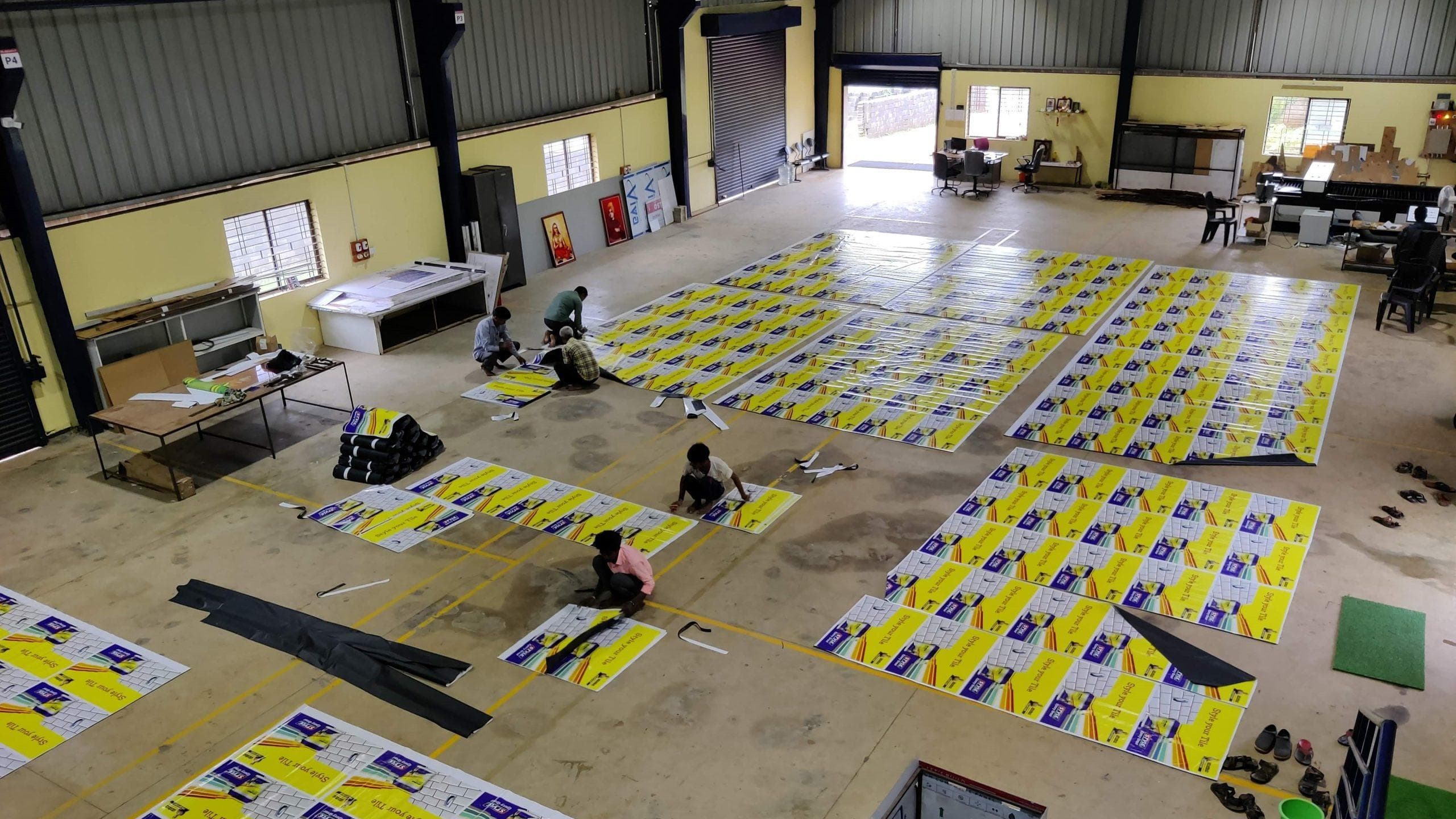
Multi-city signage logistics is the operational layer that distinguishes a vendor who can fabricate from a vendor who can deliver. Most vendors quote competitively on production. Many vendors quote competitively on installation. Few vendors price the logistics realistically, and the gap between the two is where multi-city projects either succeed or fail.
The operational reality of moving signage hardware across India.
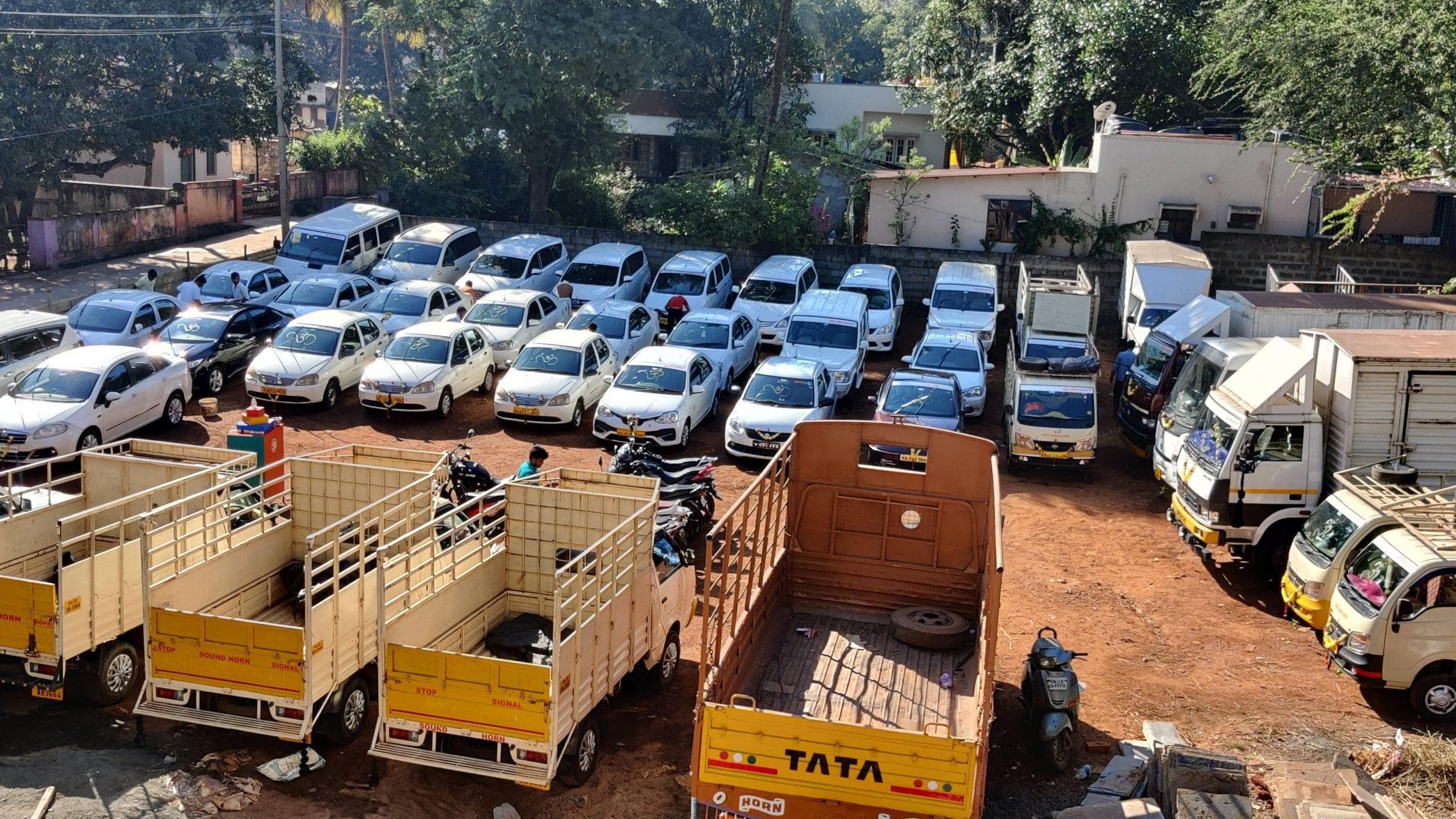
The modes. There are four primary transport modes for signage hardware: full truckload, part truckload, surface courier, and air freight. Full truckload is economical for high-volume single-destination shipments, typically more than 8 cubic metres. Part truckload is economical for medium-volume shipments where a dedicated truck is not justified, typically 1 to 8 cubic metres. Surface courier handles smaller consignments, typically less than 1 cubic metre, with longer transit times but lower per-shipment costs. Air freight is reserved for emergencies, prototypes, or shipments where transit time is more critical than cost.
The routing. India's road logistics network operates on hub-and-spoke patterns. A shipment from Dharwad to Pune can move directly. A shipment from Dharwad to Guwahati typically routes through Hyderabad or Bangalore to a major eastern hub before final-mile delivery. Routing affects transit time, handling count, and damage risk. Each handling event adds risk. A direct-route shipment is operationally safer than a multi-leg shipment of the same scope.
The transit times. Local Karnataka and northern Karnataka destinations: 1 to 2 days from Dharwad. South India destinations including Maharashtra, Andhra, Telangana, Tamil Nadu, Kerala: 2 to 4 days. North India destinations including Delhi NCR, Punjab, Haryana, Rajasthan, Gujarat: 4 to 6 days. East India destinations including West Bengal, Bihar, Jharkhand: 5 to 7 days. Northeast destinations including Assam, Meghalaya, Tripura: 7 to 12 days. These ranges assume normal operating conditions. Monsoon, festival season, and political disruption (bandhs, transporter strikes) can extend each range.
The packaging. Signage hardware is fragile in specific ways: acrylic faces scratch and crack, LED modules are sensitive to mechanical shock, painted surfaces mark on contact with rough surfaces, electrical components are sensitive to moisture, and structural members are heavy and require correct load distribution to avoid damaging lighter components packed alongside. Proper packaging uses cushioning material around fragile faces, separate packing for electrical components, weather wrapping for monsoon-season shipments, and load-distribution inserts for mixed shipments. Packaging accounts for 3 to 7 percent of finished hardware cost on multi-city shipments. Vendors who skimp on packaging save the cost upfront and incur damage costs at site.
The sequencing. Multi-city rollouts require dispatch sequencing rather than bulk shipment. Sites with the longest install lead times, the most restrictive permit windows, or the earliest project deadlines should dispatch first. Sites with flexible install windows can dispatch later. The sequencing protects the project from situations where install crews arrive at multiple sites simultaneously and find that the hardware they need is on a truck somewhere between Mumbai and Kolkata. A serious project plan has a dispatch sequence document, not just a cumulative ship date.
The documentation. Each shipment requires an invoice, an e-way bill (mandatory for shipments above the GST threshold), a packing list, a delivery challan, and any state-specific transit documents. Errors in documentation cause checkpost delays that can extend transit by days. Multi-state operations need a documentation desk that handles this paperwork without involving the production team or the project manager. Vendors who treat documentation as an afterthought generate transit delays as a recurring problem.
The insurance. Multi-city signage shipments should be insured. The premium is small relative to the asset value: typically 0.1 to 0.3 percent of declared value. The risk is real: hardware damage in transit, consignment loss, theft, and weather damage all happen at non-trivial rates. Vendors who insure shipments by default protect both their margin and the client's project. Vendors who skip insurance to save the premium are transferring the risk to whoever bears the consequence.
The last-mile reality. The truck delivers to a destination address. The hardware then needs to move from the destination to the install location, which may be a few metres or several kilometres depending on the site context. Last-mile handling at the destination is a recurring source of damage and delay. Vendors with established multi-city operations have local pickup-and-deliver partners in major cities who manage the last mile professionally. Vendors without these partnerships subcontract to whoever is available at the time, with variable results.
The coordination layer. Multi-city logistics is coordinated through a logistics desk that tracks dispatches, transit milestones, delivery confirmations, and any exceptions. The desk communicates with the production floor for outbound dispatch, with the transporter for in-transit status, with the local install team for receipt and pre-install verification, and with the project manager for status reporting. A vendor without a defined logistics desk runs multi-city projects through ad-hoc coordination, which scales poorly beyond a handful of sites.
The weather window. Monsoon affects logistics in three ways: road conditions slow transit, particularly in coastal and Western Ghats regions; cargo handling becomes risky for moisture-sensitive components; and the install windows at site shrink. Multi-city projects scheduled for July-September execution should add 30 percent buffer on transit time and on install duration. Projects scheduled for October-March face fewer weather-related disruptions but coincide with festival-season transporter shortages, which is its own constraint.
The cost structure. Logistics costs typically account for 5 to 12 percent of total project cost on multi-city signage rollouts. The variation is driven by destination distance, mode mix, packaging requirements, and dispatch frequency. Procurement teams should expect logistics to be a real line item in the BOQ rather than a hidden contingency. Vendors who flat-price logistics across all destinations are either over-charging on near sites or under-charging on far ones, and the under-charge will become a change order or a damage claim.
The risk events. Common multi-city logistics risks: transit delay due to road or weather disruption, transit damage to fragile components, documentation errors causing checkpost detention, last-mile delivery to wrong address, theft from unattended consignments, and force majeure events including transporter strikes. A vendor with multi-city experience has playbook responses for each of these. A vendor without that experience escalates each event to the project manager and asks for guidance, which is operationally exhausting and project-disruptive.
The procurement signal. Vendors who can articulate their logistics approach in detail, name their transporter partners, explain their packaging protocol, describe their dispatch sequencing logic, and walk through their weather-buffer methodology are vendors who have run multi-city projects before. Vendors who answer logistics questions in generalities are vendors whose multi-city operations are aspirational rather than operational.
For multi-city signage projects across India, our /services pages cover the scope, the /works gallery includes installations spanning multiple states, and the /downloads page hosts our standard logistics planning template. The /contact form routes multi-city RFQs to the project planning desk for a structured response with phase-wise dispatch sequencing.