Every June, the same calls come in. A retail chain with branches across coastal Karnataka and Maharashtra reports that 40 percent of their fascia signs are now degraded in some way. A bank with branches in Bengaluru reports water staining behind their channel letters. A real estate developer in Mumbai discovers their site hoarding has begun to delaminate at the top edge. The pattern is not random. Indian monsoon damages outdoor signage in repeatable ways, and once you have run AMC across two or three monsoon cycles in the geographies we operate in, you can predict almost every failure category before the rains start.
The first pattern is water ingress through compromised seals. Silicone seals degrade from UV before they fail from water. By the time the monsoon arrives, the seal that was perfect at install three summers ago has lost elasticity, developed micro-cracks, and is now a wick rather than a barrier. The first heavy rain pulls water past the seal by capillary action, the second floods it. Pre-monsoon AMC visits in May target exactly this category, replacing seals on every penetration and joint before they have to perform under pressure. The cost of a tube of silicone is negligible, the cost of a fascia rebuild is not.
The second pattern is structural water staining from inadequate flashing. A channel letter mounted to a wall without a top flashing or a properly angled drip edge will stain the wall below it within one monsoon. The stain is permanent without sandblasting and repainting, and the only fix is to add the flashing that should have been there at install. Banks and corporate clients with brand-aligned facade aesthetics tend to be most sensitive to this, and a single staining incident often becomes a property management dispute that takes months to resolve.
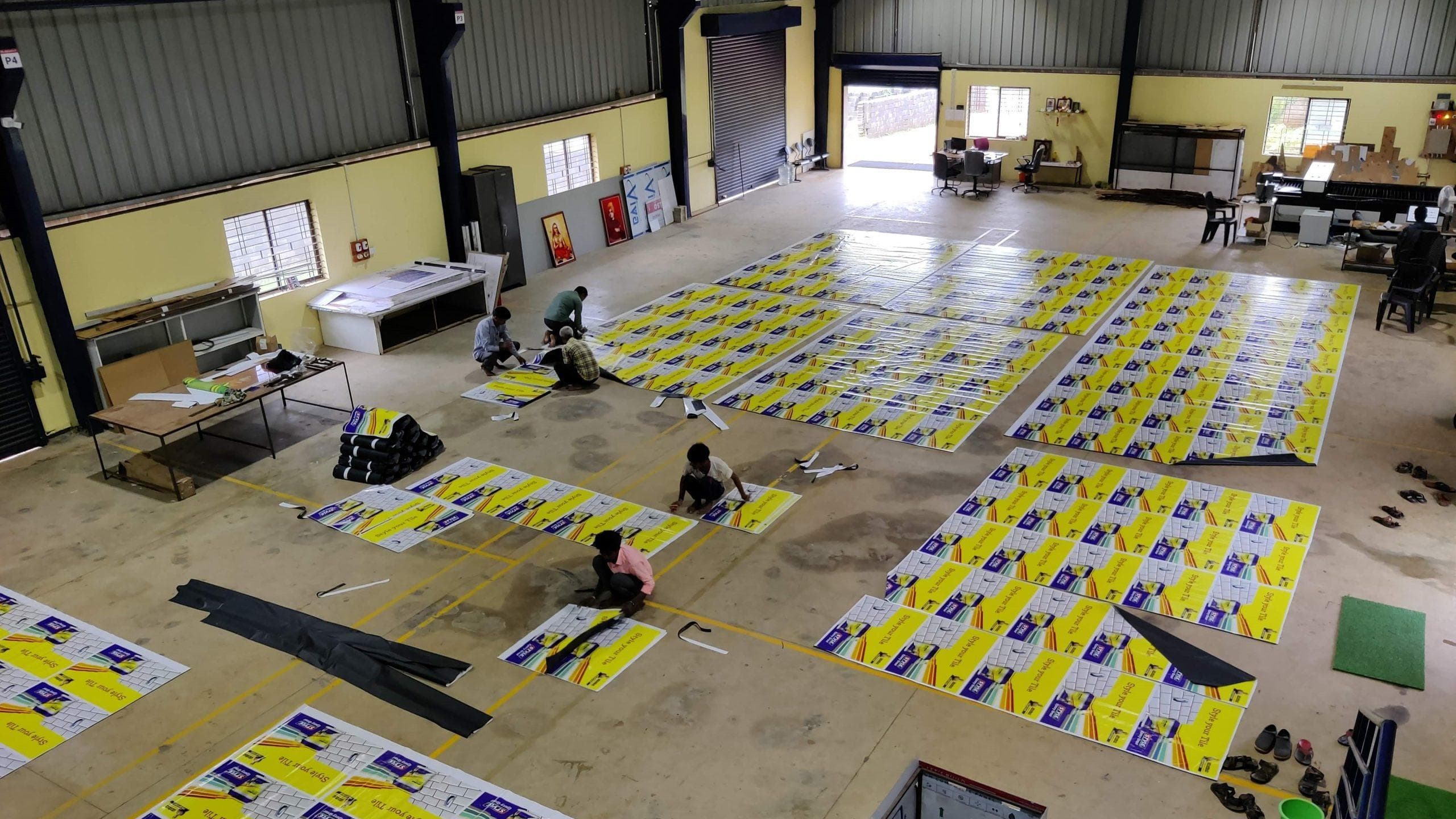
Third, vinyl edge lift on hoardings, building wraps, and large-format facade graphics. The mechanism is consistent. Wind-driven rain finds an edge that was not properly heat-sealed or capped, water travels under the vinyl, the adhesive bond fails, and within 48 hours of sustained wind the corner that was lifted by 2 cm is now lifted by 30. Pre-monsoon edge inspection and re-sealing is one of the highest-ROI AMC interventions in coastal cities. Post-monsoon, the same vinyl that could have been saved with a 200 rupee re-seal now needs full replacement at 20 to 40 thousand depending on size.
Fourth, ACP delamination. Composite panels delaminate when water gets between the aluminium skins and the polyethylene core. The entry point is almost always a cut edge that was not properly sealed, or a fastener hole drilled without grommet and sealant. Once delamination starts, it propagates with each thermal cycle. By the third monsoon, an unsealed edge cut at install can have delamination running 15 to 20 cm into the panel, and the only fix is panel replacement. Edge sealing is not optional, it is the single most consequential install detail on any ACP fascia.
Fifth, drainage failure. We mentioned weep holes in the channel letter context, but the same principle applies at scale. ACP fascia frames hold water if the bottom rail is not drilled. Light box returns hold water if the lower edge is sealed solid. Pylon bases hold water if the foundation is not properly graded. After the monsoon, a sign that holds water becomes a sign that grows mould inside it, which becomes a sign with corroded wiring, which becomes a sign that fails electrically the following year. Water management is the invisible 80 percent of monsoon-resilient signage.
Sixth, electrical and ground faults. Power inlets to outdoor signs often pass through wall penetrations that were sealed adequately at install but have degraded. Water tracks down the cable, into the conduit, and into the driver enclosure. Earthing connections corrode in humid conditions and lose continuity, which can turn into a leakage current that trips breakers without warning during a heavy rain. AMC partners that include earth continuity testing as part of their pre-monsoon protocol catch these before they become safety incidents.
Seventh, structural movement. Heavy monsoon winds load fascia signs and channel letters in ways that summer winds do not. Fasteners that have loosened slightly over the year find their slack pulled out by gusts, and the sign starts to move. Movement creates new water pathways, which accelerate every other failure. A pre-monsoon torque check on every visible fastener is fast, costs almost nothing, and prevents the chain reaction.
Eighth, mould and biological growth on white substrates. ACP and white-faced light boxes in humid coastal climates begin to host mould within one monsoon, especially on north-facing surfaces that do not get direct sun. The cosmetic impact is significant for premium brands, and once mould has established it is hard to remove without damaging the surface finish. Anti-fungal cleaning agents applied during pre-monsoon visits, plus post-monsoon cleaning rounds, manage this. A surprising number of brand audits flag this as a complaint without realising it is a maintenance category, not a design defect.
There is also a logistics layer to monsoon AMC that brand teams underestimate. Crews cannot work safely on outdoor signage during active heavy rain, which means the productive window for repair work compresses. Procurement of parts often slows because suppliers face the same logistics constraints. Site access becomes harder where roads flood or building courtyards are inundated. A pre-monsoon push that completes 70 to 80 percent of vulnerable site interventions before the rains start is not just better engineering, it is a practical response to the operational reality that mid-monsoon work is slower, more expensive, and more dangerous.
A practical pre-monsoon checklist looks like this: inspect and replace all silicone seals, verify all weep holes are clear, re-seal vinyl edges and wrap corners, torque-check all visible fasteners, inspect ACP edge seals and reseal where needed, test earth continuity on all powered signs, clean drainage paths in lightboxes and pylons, and document the pre-monsoon condition photographically. Post-monsoon visits then compare against the pre-monsoon record and identify which interventions worked and which need to be rethought next year.
The geography matters. Coastal cities, the Western Ghats, and the high-rainfall belts of Karnataka, Maharashtra, Goa, Kerala, and the northeast all need a more aggressive monsoon protocol than the dry interior. Even within a state, the difference between a Bengaluru install and a Karwar install is significant, and the AMC schedule needs to reflect it. A pan-India network with sites in both wet and dry geographies should run two distinct monsoon protocols on different calendars rather than a single uniform program that under-serves the wet sites and over-serves the dry ones.
There is a budgeting rhythm that supports monsoon resilience. Pre-monsoon visits typically fall in April and May, post-monsoon assessment in September and October, and any structural rectification or panel replacement work in the October to December window when weather is favourable for outdoor work. Brands that align their facilities budget release with this rhythm avoid the common pattern of approving repair budgets in January when the damage is six months old and the rectification is now harder and more expensive. The annual cadence is not arbitrary, it follows the climate.
Document every monsoon as a learning event. The post-monsoon report should not just list damage and cost, it should identify which interventions worked, which did not, and what the implications are for next year's pre-monsoon plan and the install spec for the next batch of sites. Brands that treat each monsoon as a data point in a multi-year learning loop converge on dramatically lower damage rates by year three or four. For a pan-India AMC framework that builds these realities into the service calendar, see /amc and /works for examples of monsoon-resilient installs. For the install standards that prevent the most expensive monsoon damage categories from happening at all, see /quality and /services.