Material wastage in large-format printing is one of those production realities that vendors prefer not to discuss in quotations and clients prefer not to ask about. But it is real, it is unavoidable, and the way a vendor handles it determines both the per-unit cost they can offer and the environmental footprint of the printed work over a year.
Understanding the wastage standards in this category lets procurement teams calibrate what is normal, what is acceptable, and what is a vendor problem disguised as a billing line.
The categories of wastage. Material wastage in large-format printing falls into five categories: substrate trim waste, print-setup waste, color-calibration waste, finishing waste, and damage waste. Each has its own range of normal values and its own root causes.
Substrate trim waste. Roll-to-sheet conversion and panel layout always generates trim. A 1.5-metre wide roll being cut into a 1.2-metre wide print leaves 300mm of trim per metre run, which represents a 20 percent material loss before any printing happens. A skilled production planner mitigates this by laying out multiple jobs on the same roll and by selecting roll widths that minimise trim against the active job mix. Trim waste of two to five percent on a well-planned production line is normal. Trim waste of ten percent or more indicates poor production planning.
Print-setup waste. At the start of each new substrate or each new color profile, the printer runs a series of test prints to verify head alignment, color accuracy, and substrate adhesion. These test prints are written off as setup waste. A standard UV printer setup consumes between 0.5 and 1.5 square metres of substrate. A latex printer setup consumes between 0.3 and 1.0 square metres. Setup waste is necessary because the alternative (skipping setup) produces an entire production run with a consistent defect that requires reprinting at full cost. Vendors who minimise setup by batching similar jobs amortise the setup waste across multiple work orders.
Color-calibration waste. Critical color matching, particularly for brand-specified colors that need to fall within a defined Delta-E tolerance, requires iterative test prints with adjusted color profiles. This calibration can consume between one and three square metres on a complex job. The waste is highest when the vendor is matching to a physical reference (a brand sample, a Pantone chip) rather than to a digital target. Calibration waste is amortised across the run length: a 200-square-metre print can absorb a square metre of calibration waste at half a percent. A 5-square-metre job carries the same calibration burden at 20 percent overhead, which is why small custom jobs carry higher per-unit pricing.
Finishing waste. Cutting, hemming, eyeleting, and welding generate scraps that cannot be reused. Bleed allowances around printed elements, typically 5mm to 10mm per edge, are designed to be cut off during finishing. Hem allowances on banner edges, typically 25mm to 50mm, are folded back during finishing and remain part of the finished piece. Mistakes during finishing (mis-aligned cuts, damaged hems) generate additional waste that should not exceed two to three percent of input material in a well-run finishing department.
Damage waste. Material handling damage, accidental scratching during finishing, ink head crashes, and substrate folding during transit between production stages all generate write-off waste. Damage waste of one to two percent is normal. Damage waste of five percent or more indicates a workflow that needs to be redesigned.
Total wastage benchmarks. A well-run UV print job on standard substrate, in a typical production batch, generates total material wastage of seven to twelve percent. A latex print job on similar substrate generates total wastage of six to ten percent. A solvent print job on banner material generates total wastage of eight to fourteen percent because of higher trim losses and finishing complexity. These benchmarks include trim, setup, calibration, finishing, and damage. Vendors operating significantly above these ranges are either inefficient or are billing for wastage that should be absorbed into the rate.
How wastage is priced. There are two billing models. The first absorbs wastage into the per-square-metre rate, so the printed area you pay for matches the printed area you receive, and the vendor manages wastage within their margin. The second invoices the gross material consumed including wastage, so the per-square-metre rate is lower but the actual quantity charged is higher than the finished area. Both models are legitimate, but the first is friendlier to procurement teams who need predictable pricing for budgeting purposes.
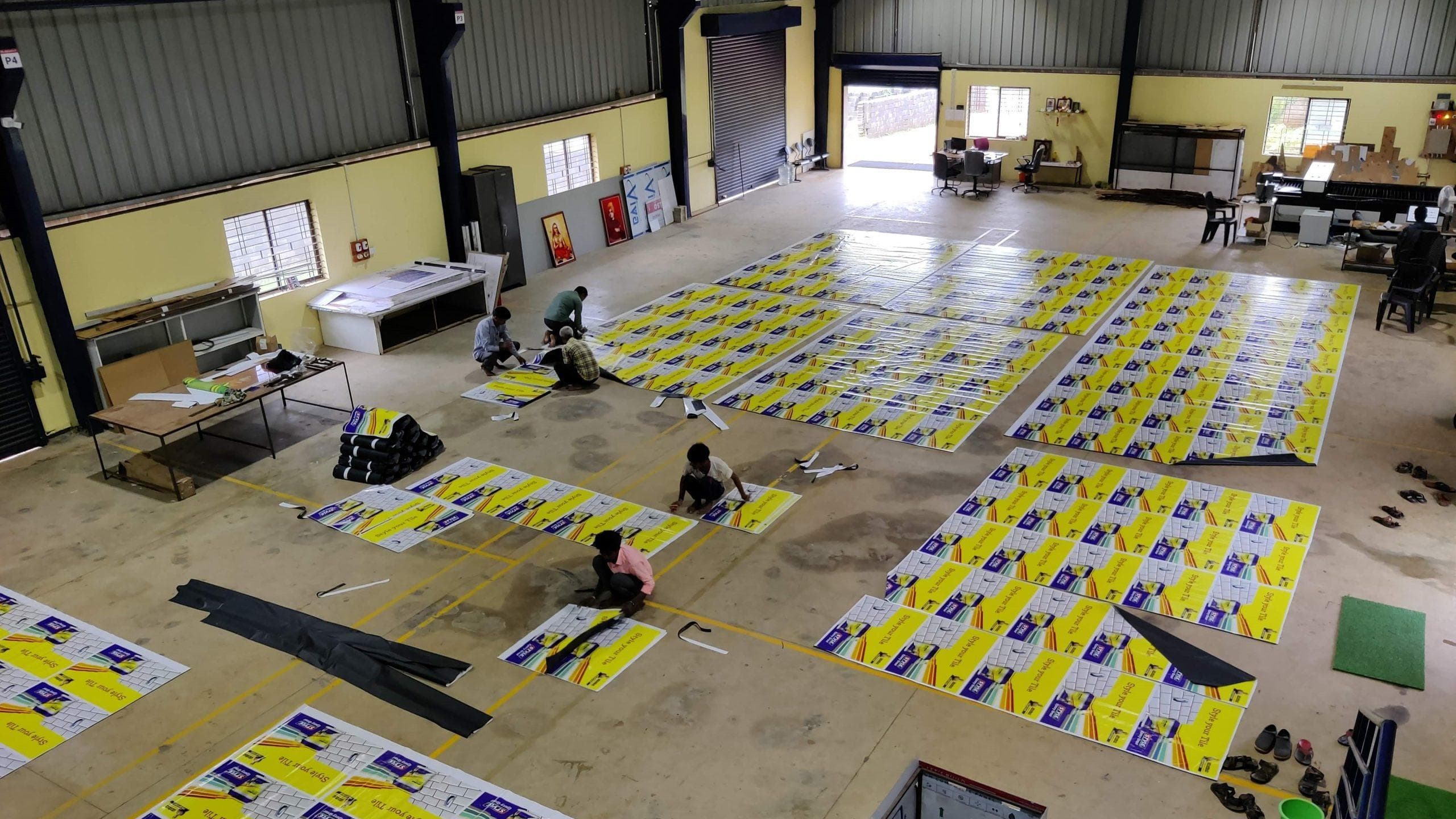
The environmental dimension. Large-format printing wastage is meaningful in absolute terms when integrated over a year of production. A vendor running 100,000 square metres of UV-printed PVC banner per year, at 10 percent wastage, generates 10,000 square metres of waste material. PVC banner is not easily recyclable in most municipal systems. The waste typically goes to landfill or to incineration. Vendors who have invested in waste-reduction processes (better production planning, batched setup, off-cut reuse for sample work, partnerships with downstream recyclers) operate at the lower end of the wastage range and generate measurably less landfill output. Procurement teams with sustainability mandates should ask vendors about wastage rates and downstream waste handling.
Off-cut reuse. Some categories of off-cut have legitimate downstream uses. Vinyl off-cuts can be repurposed for sample prints, internal projects, or trial runs. Acrylic off-cuts can be used for hardware mockups or for finishing trials. ACP off-cuts can be retained for repair work on existing installations. A production floor that captures and reuses off-cuts reduces effective wastage. A production floor that bins everything is generating preventable waste.
Material selection and wastage. Some materials are more forgiving of wastage than others. PVC banner is widely used because it is cheap to replace, accepts most ink chemistries, and has a tolerant production window. Premium substrates like backlit polyester or specialty acrylic are less forgiving, and a single damaged sheet can compromise the economics of a small custom job. Vendors who handle premium substrates regularly have invested in handling protocols, dedicated cutting jigs, and trained operators. Vendors who occasionally take on premium-substrate jobs without these investments often pass damage waste back to the client as a billing line.
Wastage and the small-job economics. Wastage is the dominant cost driver on small print jobs. A 2-square-metre print job will incur the same setup and calibration waste as a 200-square-metre job, but the cost cannot be amortised. This is why small-quantity printing is disproportionately expensive per square metre and why vendors often have a minimum order quantity. Procurement teams ordering small quantities should consolidate where possible, batch with other small orders if the vendor supports this, or accept that the per-unit pricing reflects the wastage overhead.
Wastage and turnaround time. Faster turnaround often correlates with higher wastage because there is less time to optimise production layout, batch similar jobs, or run extended calibration. A 24-hour turnaround on a custom print job will typically carry higher effective wastage than a 5-day turnaround on the same scope, and the per-square-metre rate may reflect this. Procurement teams who can plan ahead get better economics.
For procurement teams evaluating vendors on wastage rates, the right question is not 'what is your wastage rate' (every vendor will quote something flattering). The right questions are: how do you manage trim waste in production planning, what is your setup batching policy, how do you handle calibration waste on small jobs, and what happens to your off-cuts at end of run. Vendors who can answer these specifically are vendors operating at the better end of the range. Vendors who answer in generalities are vendors whose wastage is unmanaged.
Our production approach is documented under /services with /quality covering the controls that hold the wastage benchmarks accountable. The /works gallery shows the kind of large-format work where wastage discipline directly determines the project economics.