Choosing a digital print ink chemistry without understanding the trade-offs is a common procurement mistake. The brochures from the printer manufacturers conflict, the vendor recommendations conflict, and the cost gap between the chemistries is large enough that the wrong choice changes a project budget significantly. This is the technical comparison that should sit on a procurement desk before any large-format printing tender is awarded.
Four ink chemistries are in commercial use in India for large-format work in 2026: solvent, UV-curable, latex (water-based with heat curing), and eco-solvent. Each has a chemistry profile, a substrate compatibility envelope, an outdoor durability rating, and an operator and environmental impact profile.
Solvent ink is pigment dispersed in aggressive organic solvents — typically cyclohexanone or related compounds. The print process deposits the ink onto the substrate, the solvent evaporates and partially dissolves the surface of the receiving vinyl or banner film, the pigment becomes embedded in the surface layer, and the result is a print that is chemically integrated into the substrate. Outdoor durability is excellent — five to seven years unlaminated, eight plus laminated. Colour gamut is wide, particularly in the saturated reds, blues, and greens that brand work demands. The trade-offs are real: significant VOC emissions during printing and outgassing, mandatory exhaust ventilation in the print room, 24 to 48 hour outgassing required before lamination, longer drying time, and operator health considerations that have led most modern installations away from true solvent except for very high-volume hoarding work.
UV-curable ink is liquid acrylate-based ink containing photo-initiators. The ink is liquid until it passes under UV light (UV-LED or UV-mercury), at which point the photo-initiators trigger polymerisation and the ink cures into a hard plastic film instantly. Zero VOC emissions during printing because there is no solvent to evaporate. The cured ink film is hard, scratch-resistant, and chemically robust. UV inks print on virtually any substrate — rigid materials like ACP, foam board, glass, acrylic, MDF, wood, ceramic, metal, and flexible materials with appropriate primers. Outdoor durability runs three to five years unlaminated, seven plus laminated. The white ink option (a separate ink channel for laying down white as a base or spot layer) is standard on UV machines and is what enables premium backlit work and printing on transparent or coloured substrates.
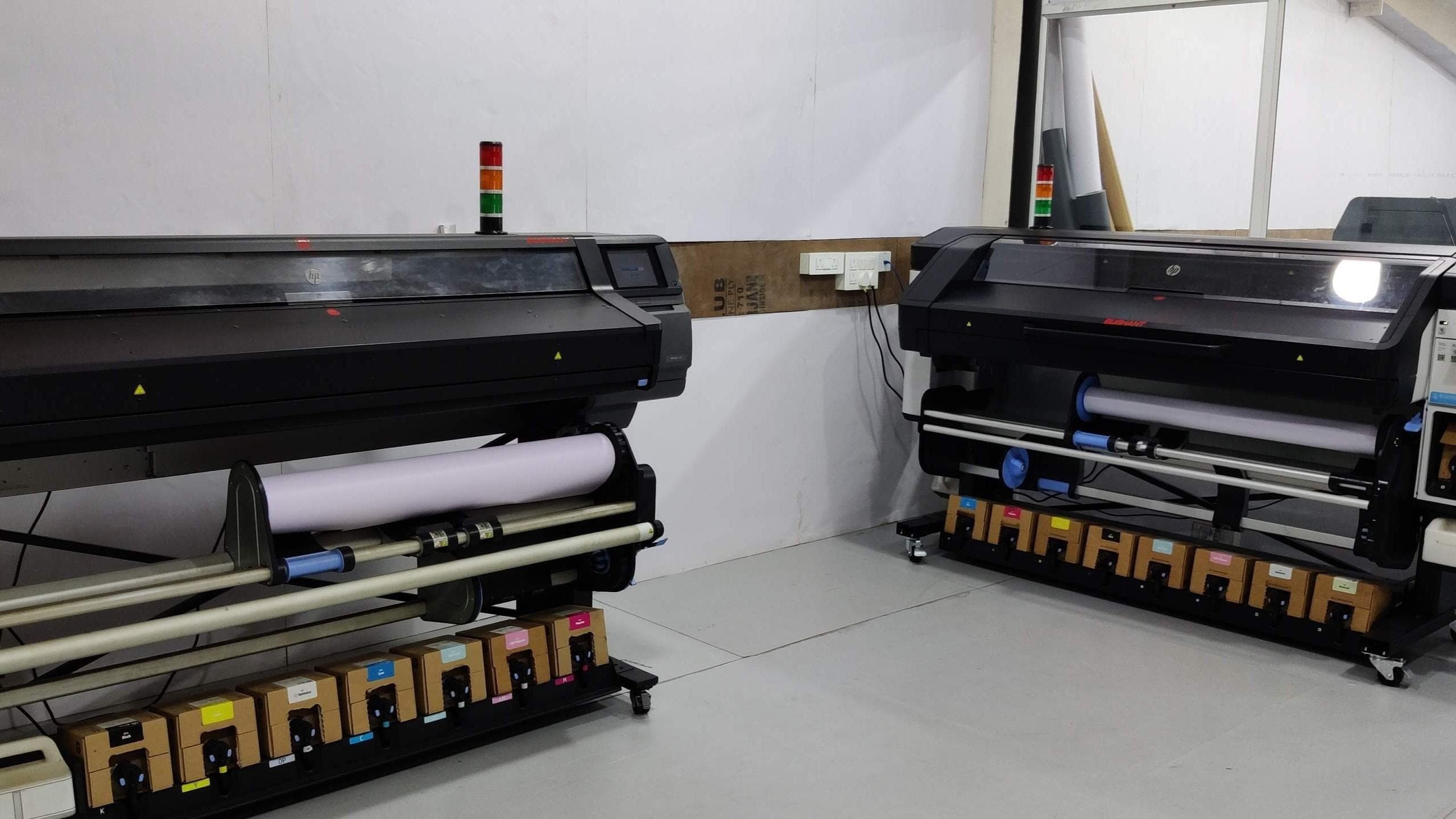
Latex ink is water-based with pigment held in a polymer dispersion. The print process lays down the ink, then the substrate passes through a heated drying zone (typically 100 to 120 degrees Celsius) that evaporates the water and fuses the polymer film onto the substrate. Output is dry and ready to laminate within minutes of printing. VOC emissions are minimal — water-based chemistry means no solvent fumes. The polymer film is flexible, conforms well to vehicle wraps, and the ink chemistry is compatible with PVC-free substrates which is important for indoor air quality compliance in environments like hospitals, schools, and corporate offices targeting LEED or IGBC ratings. Outdoor durability runs three to five years unlaminated, six to eight years laminated. HP is the dominant latex machinery vendor in India through their Latex 100, 300, 500, and 700 series.
Eco-solvent uses milder glycol ether solvents — still solvents in chemistry but lower in VOC and less aggressive on operator health than true solvent. The ink works similarly to solvent in process, with somewhat shorter outgassing times (12 to 24 hours), wider substrate compatibility, and outdoor durability slightly behind true solvent (three to five years unlaminated, seven plus laminated). Roland, Mimaki, and Mutoh dominate eco-solvent machinery in India.
The substrate compatibility matrix. Cast vinyl wrap film: eco-solvent, latex preferred. UV is too rigid for compound curve work. Flex banner: solvent or eco-solvent ideal, latex acceptable, UV not standard. ACP rigid panel: UV ideal (direct print, no lamination required), solvent and eco-solvent require print on vinyl then mount. Foam board (PVC foam): UV ideal direct print, eco-solvent on overlay vinyl. Glass and acrylic rigid: UV with proper primer, no other chemistry suitable for direct print. PVC-free fabric and wallcovering: latex preferred for indoor air quality, eco-solvent acceptable. Backlit film PET: UV with white ink layer for premium, eco-solvent or latex for standard. Vehicle wrap PVC: eco-solvent or latex.
The outdoor durability picture, unlaminated, on appropriate substrate. Solvent: 5 to 7 years. Eco-solvent: 3 to 5 years. UV-cured: 3 to 5 years. Latex: 3 to 5 years. Lamination adds 2 to 4 years to all chemistries. Premium UV-blocking laminate adds 4 to 6 years.
The environmental and operator profile. VOC emissions: solvent high, eco-solvent moderate, UV near zero, latex near zero. Indoor air quality compatibility: latex best, UV second, eco-solvent acceptable with ventilation, solvent requires dedicated ventilated room. LEED and IGBC compliant project requirement: typically latex or UV, occasionally eco-solvent acceptable depending on project spec.
The cost picture, May 2026, per square foot, mid-volume, single-side print without lamination. Solvent on flex banner: rupees 28 to 45. Eco-solvent on cast vinyl: rupees 45 to 70. UV direct to ACP: rupees 65 to 95. Latex on PVC-free wallcovering: rupees 95 to 140. Lamination adds 15 to 30 per square foot.
The procurement framework. Match the ink chemistry to the substrate, the install location, and the required life. For long outdoor hoarding life on flex banner, solvent or eco-solvent. For premium retail lightbox face with white ink layer, UV. For indoor wall murals in spaces with air quality requirements, latex. For vehicle wraps, eco-solvent or latex. For direct print on rigid signage face, UV. For high-end backlit signage with daytime visibility, UV with white ink.
Quality differentiators within each chemistry. Droplet size — 4 picolitre and below is photo quality, 6 to 8 picolitre is standard sign work, 12 plus is large banner only. Resolution — 720 x 720 dpi is standard, 1440 x 720 or 1440 x 1440 is photo quality. Bidirectional versus unidirectional printing — bidirectional faster, unidirectional cleaner. Print head technology — Kyocera, Ricoh Gen5, and Konica Minolta are the premium head brands; Epson DX heads are the budget standard.
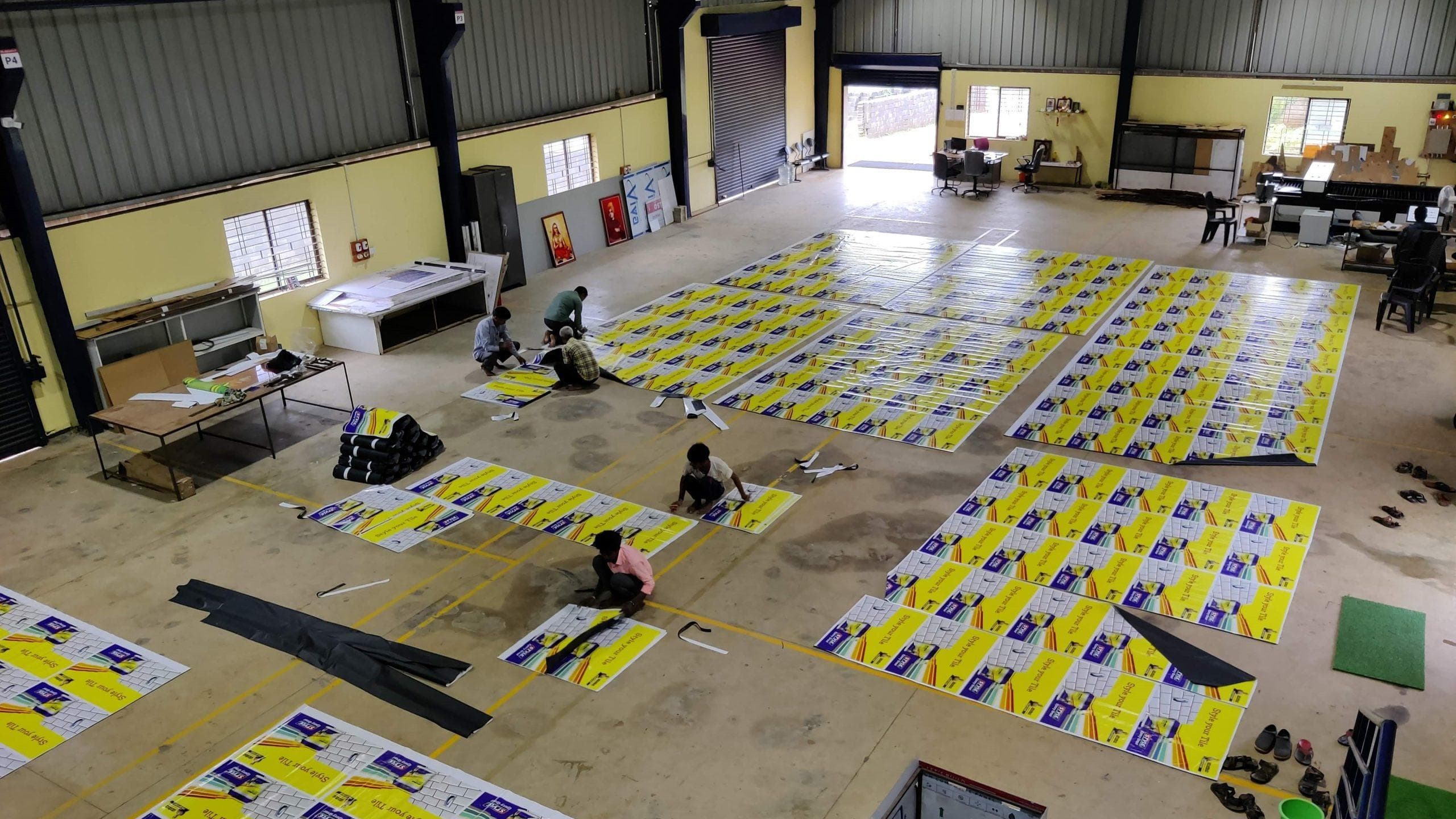
We run UV (Kyocera-head flatbed), eco-solvent, and latex on the production floor — see the equipment list on /services and the typical project specifications on /works.
A few additional procurement considerations on ink chemistry selection. Inkjet droplet size determines image fineness and is a real differentiator between machine grades. Photo-quality work — backlit retail graphics, premium hospitality printing, fine-detail corporate work — needs 4 picolitre or smaller variable droplet capability. Standard sign work — banners, vehicle wraps, retail point-of-sale — runs comfortably at 6 to 8 picolitre fixed droplet. Large banner work — hoardings, building wraps, high-volume billboard production — runs at 12 picolitre or larger to maximise throughput speed. Match the droplet size to the print resolution requirement and the viewing distance.
Resolution claims on machine spec sheets need careful reading. Marketing literature often quotes the highest theoretical resolution (1440 x 1440 dpi or higher) which is achievable only at the slowest print mode. Real-world production resolution for sign work is typically 720 x 1080 dpi or 720 x 1440 dpi at sensible production speeds. Specify the production resolution and the print speed both, not just the maximum theoretical resolution.
White ink and varnish channels are premium machine features that matter for specific applications. White ink enables printing on transparent and coloured substrates, layered backlit graphics, and three-dimensional spot effects on rigid signage. Varnish — clear UV-curable lacquer applied as a separate channel — enables matt-spot-on-gloss effects, tactile dimensional finishes, and additional surface protection for high-touch retail work. Not every printer has these channels; if the design intent calls for them, verify the machine capability before awarding the print job.
Pantone matching capability is the brand procurement question. Quality print vendors maintain a Pantone bridge calibration that translates Pantone spot colours to the closest achievable CMYK plus light cyan, light magenta, white, and varnish where available. Best-in-class vendors achieve a Delta E (colour difference metric) of less than 3 against the Pantone reference, which is essentially indistinguishable to the human eye. Budget vendors achieve Delta E of 6 to 10, which is visibly off for trained brand operations eyes. Ask the vendor to demonstrate Delta E test results on a Pantone bridge if your brand identity is colour-critical.
The right ink chemistry is project-specific; send the substrate, install location, required life, and brand colour reference to /contact and we will quote with the chemistry, machine, and colour management workflow that matches the brief.