Backlit film is the unsung hero of every lightbox you have ever stood in front of. The film is the print substrate that lives at the front of the box, with LED modules behind it, and your job specifying the backlit film correctly is the difference between a lightbox that glows evenly and reads beautifully at night and one that shows the LED grid pattern through the face like a constellation map.
The two main categories of backlit film for signage lightboxes are PVC backlit film (sometimes called duratrans-style) and polyester (PET) backlit film. Within these, the spec divisions that matter are opacity grade, surface finish, and ink compatibility.
PVC backlit film is the traditional standard. Typical thickness 200 to 300 micron, gsm in the range of 270 to 360. The film is white-pigmented PVC with a coated print receptive layer on the front face. Light transmission for sign-grade PVC backlit is typically 30 to 50 percent — the higher the transmission, the brighter the lit appearance but the more visible any LED hot spots become. The lower the transmission, the more diffused and even the lit face but the dimmer the result. Standard grades for retail signage land at 40 percent transmission as a working middle. The film is compatible with solvent, eco-solvent, UV, and latex inks depending on the receptive coating spec.
Polyester (PET) backlit film is the higher-end option. Thickness 175 to 250 micron, very dimensionally stable (does not shrink or stretch with humidity changes), excellent optical clarity, and superior diffusion characteristics. Typical light transmission 35 to 55 percent. PET films come in matt, satin, and high-gloss finishes — for backlit work, matt or satin is usually correct because gloss reflects ambient light during daytime when the box is unlit. PET is the standard for premium retail, hospitality, and any application where the lightbox doubles as a daytime graphic (most do — the box is on for 14 hours but visible for 24).
Grey-back versus white-back films. The standard backlit film is white front (print receptive) and white back. For lightboxes installed where ambient ghosting is a concern — daytime graphic clarity issues, dual-sided lightbox with bleed-through between faces, or installation in front of a reflective wall — a grey-back film is specified. The grey back blocks back-side light and reduces ghosting, but reduces overall light transmission by 10 to 15 percent. For double-sided pylon signage with separate graphics on each face, blockout-back film (opaque blockout layer between two print receptive faces) is the correct spec.
Light transmission and diffusion behaviour. The relationship between LED spacing in the lightbox, lightbox depth (the distance from the LED back panel to the film face), and the diffusion characteristics of the film is what determines visual evenness. Rule of thumb: for LED module spacing of 250 mm in both directions, you need lightbox depth of at least 100 mm with a 35 to 40 percent transmission film to avoid visible hotspots. Tighten the LED spacing to 150 mm and you can drop the lightbox depth to 60 to 80 mm with the same film. Conversely, a deeper box (150 mm or more) tolerates wider LED spacing and brighter (higher transmission) film.
The spec questions for procurement. One: film type — PVC or PET — with brand and product code. Recognised brands for sign-grade backlit film include 3M Panagraphics, Avery Dennison Backlit, Drytac SpotOn Backlit, Mactac, Hexis Backlit, and the Asian premium suppliers like Konica Minolta and KPMF. Avoid generic unbranded backlit film for any commercial work — colour consistency between print runs is poor and ink adhesion is unpredictable. Two: light transmission percentage. Three: opacity rating (white-back, grey-back, blockout). Four: ink compatibility — confirm the film matches your printer's ink chemistry. UV-cured ink on a backlit film designed for solvent will not adhere properly. Five: thickness in micron. Six: surface finish — matt, satin, gloss. Seven: laminate compatibility — backlit film is sometimes overlaminated with a matt UV-blocking laminate to extend outdoor life and reduce daytime reflection. Confirm the laminate is compatible with the base film.
White ink layering. Premium backlit work uses a white ink layer printed beneath the colour print to control opacity and improve daytime appearance. The technique: print the white ink layer through the printer (UV, latex, and some eco-solvent printers can lay down white ink as a separate channel), then print the colour over white. The result is a graphic that appears solid and saturated when unlit during the day, and lights up brilliantly at night. Without the white layer, daytime appearance is washed out because the LED back panel is partly visible through the colour print. White ink on backlit film is the spec for any premium retail or branded lightbox.
Lamination and outdoor protection. Backlit film printed for outdoor lightbox installation should be laminated with an outdoor UV-blocking laminate (matt or satin finish) to extend outdoor life from three years (unlaminated) to seven plus years (laminated). The laminate also protects against scratching during install and routine cleaning. Skip the lamination on indoor lightboxes only.
Failure modes. Bowing or sagging of the film face: caused by inadequate tensioning during install, incorrect film thickness for the lightbox dimensions, or dimensional change of PVC film with temperature swing. Specify PET for any face larger than 1.5 m x 2 m or use a frame system that maintains tension. Discoloration of the film over time: caused by UV exposure (particularly for unlaminated PVC) or by heat from inadequately ventilated LED modules. Lightboxes need a passive ventilation pattern (small grille at top and bottom) to allow heat to escape — sealed boxes accumulate heat that yellows the film prematurely. LED dot pattern visible through the face: caused by inadequate diffusion, wrong film transmission spec, or too-shallow lightbox depth for the LED module spacing.
Cost benchmarks May 2026, per square foot, mid-volume, including print and lamination. PVC backlit unprinted: rupees 65 to 95 per square foot of film. PVC backlit printed and laminated, eco-solvent: rupees 140 to 195. PET backlit printed and laminated, UV-cured with white layer: rupees 220 to 310. Premium grey-back PET printed UV: rupees 280 to 380.
The procurement reality. The film is a small line item on the total lightbox cost — typically 8 to 15 percent of the installed price — but it is the single most visible part of the finished sign. The wrong film grade or incorrect spec choice is what makes the difference between a lightbox that looks premium and one that looks cheap. Specify the film by brand and product code, demand the lamination, demand the white ink layer for any branded application, and document the spec on handover so future face replacement can match the original.
We document backlit film specs per project — see the printing capability detail on /services and the corporate signage portfolio on /works.
A few additional procurement considerations specific to backlit work. Colour calibration for backlit print is different from front-lit print because the light source colour temperature shifts the perceived colour of the print. A graphic that looks correct under D65 daylight viewing conditions may appear noticeably different when illuminated from behind by a 6500 K LED light source, and different again under a 4000 K source. Quality vendors maintain separate ICC profiles for backlit print on their key film stocks, and ideally provide a backlit proof on the actual film and laminate the production run will use, viewed against the actual LED colour temperature spec. This is a more involved proofing process than front-lit work but is the difference between matching a brand colour exactly and being approximately close.
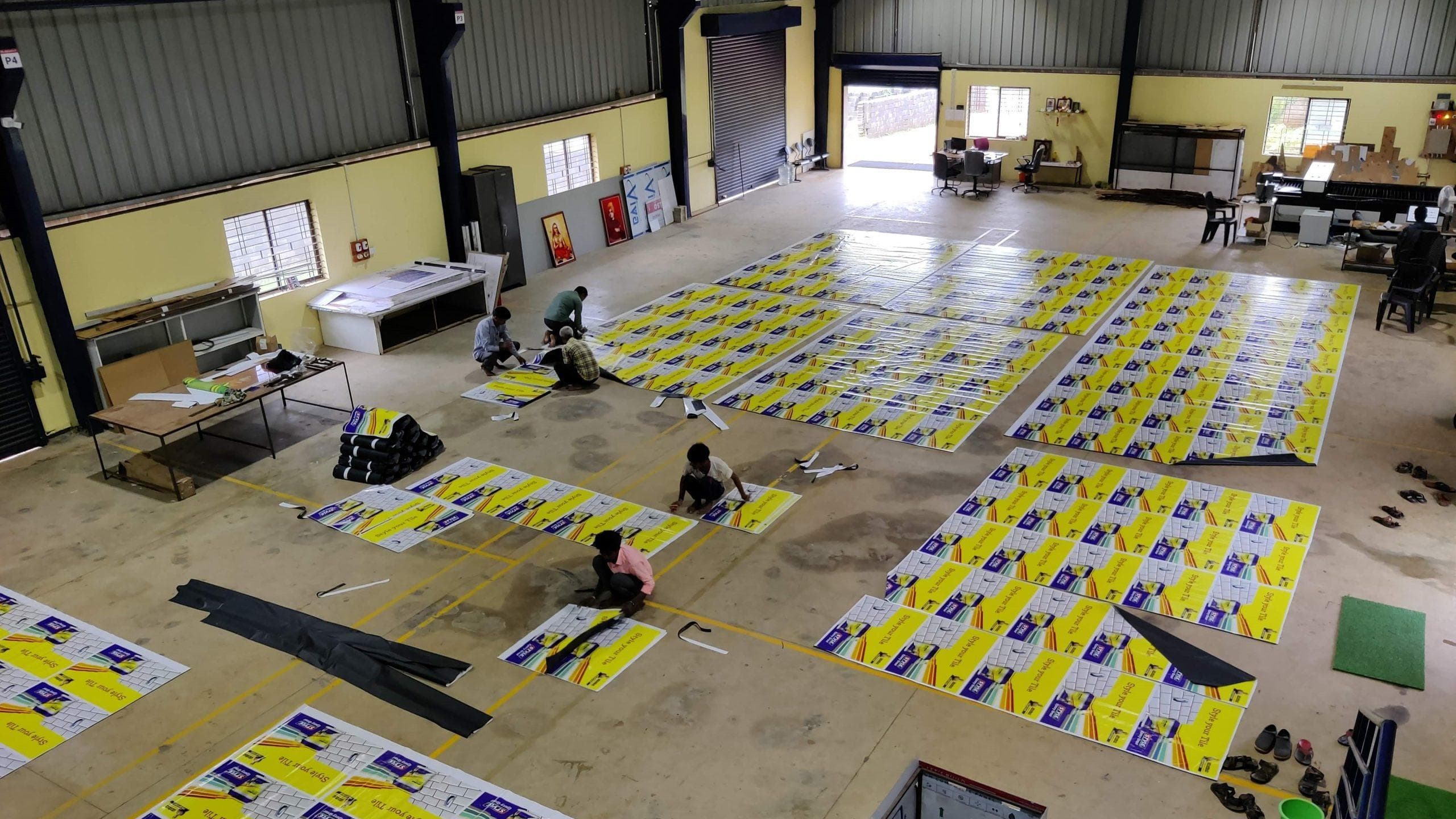
Seam handling on large lightbox faces is the practical engineering question for any face larger than the standard roll width (typically 1.27 metre or 1.52 metre depending on the printer width). Two approaches: butt seams with overlap tape behind, or clean butt joins with the seam concealed by the lightbox internal structure. The cleanest approach is to design the lightbox with a vertical or horizontal divider strip at the seam location, dividing the face into multiple panels each within roll width — this hides the seam behind the divider strip and avoids any visible join in the finished face. Alternatively, for a single continuous face required by design, plan the seam location to fall in a low-visual-interest area of the graphic (away from logos, type, and faces).
Mounting frame design for the film face. Standard methods are aluminium snap frame (the face slides into a hinged extruded aluminium frame around the perimeter, with the front bezel snapping shut over the face), tensioned silicone-edge graphic system (SEG — the face has a silicone bead on the edge that grips into a slot in the frame, very clean visual finish), and traditional clip-on frame with corner clips and concealed wire tensioning. SEG is the modern premium choice for retail and corporate work because the visible bezel is minimal and the face tension stays consistent over time. Snap frame is the workhorse standard for wayfinding and most commercial signage. Clip-on is the budget option, increasingly unusual on new builds.
Send the lightbox dimensions, design intent, and viewing conditions to /contact for a film, lamination, and frame specification recommendation.